$1 Face Value 90% Silver
Gold Silver Crypto buys and sells $1 face value 90% silver from our Highland, Utah location. We choose the specific coin type — dimes, quarters, half dollars, or a mix — included in each order from current available inventory. Orders are filled for silver content and face value, not a guaranteed coin type, date, or design.
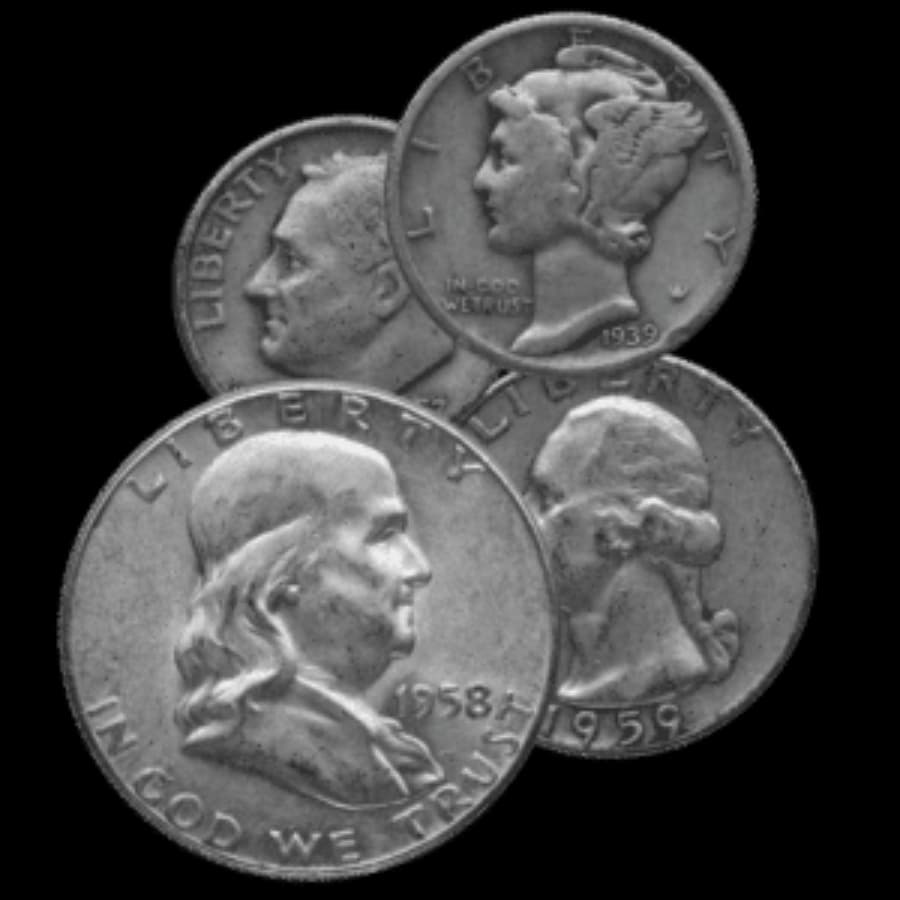
Images are for educational/reference use and may not represent current inventory.
Coin type, design, date, and condition will vary from the example shown — we select the coins from current available inventory.
$1 Face Value 90% Silver Specifications
| Metal | 90% silver, 10% copper |
| Face value | $1 |
| Approximate silver content | 0.715 troy oz |
| Possible coin types | Dimes, quarters, half dollars, or a mix |
| Possible designs | Mercury, Roosevelt, Standing Liberty, Washington, Walking Liberty, Franklin, or 1964 Kennedy |
| Manufacturer | U.S. Mint |
| Condition | Circulated; wear varies by coin |
| Coin type/design/date selection | Chosen by us from current inventory, not customer-selected |
| Primary value factors | Silver value, face value, and condition |
Pre-1965 U.S. dimes, quarters, and half dollars were all struck in the same 90% silver composition, so $1 face value always contains approximately the same silver content — about 0.715 troy ounces — no matter which denomination or coins make up that dollar.
We Buy $1 Face Value 90% Silver
Photographs can start the discussion, but final pricing requires physical evaluation of the coins.
How We Price $1 Face Value 90% Silver
An offer is built from several layers, not silver value alone:
- Current silver spot price
- Face value and coin count
- Verified silver content
- Condition
- Coin type mix, if relevant to a specific request
- Dealer and wholesale demand
- Quantity
These coins are priced for silver content and face value, not as individually graded or dated collectibles. We do not publish a fixed premium percentage or a permanent value.
Coin Type, Design, and Condition
We choose the specific coin type, design, and coins included in your order from what is currently in stock — this may be dimes, quarters, half dollars, or a mix, and is not a customer-selectable option for a standard order. Since these are circulated coins, condition also varies from coin to coin, ranging from heavily worn to lightly circulated.
If you are looking for a specific coin type, date, design, or condition rather than a standard dealer’s-choice order, contact us directly to ask whether that request can be accommodated separately from a standard order.
A Local 90% Silver Dealer Serving Highland and Utah Valley
We work with customers in Highland and nearby communities including Cedar Hills, Alpine, American Fork, Pleasant Grove, Lehi, Draper, Orem, Provo, Spanish Fork, and the surrounding Utah Valley area.
90% silver is one of the more hands-on silver categories because lots vary in denomination, condition, and composition. Instead of relying on generic online pricing, call or text us to ask what is currently available and how it is being priced today.
What Is 90% Silver?
90% silver is a common industry term for older U.S. silver coins that once circulated as everyday money but are now bought and sold primarily for their silver content. These coins are sometimes called “junk silver” — the nickname does not mean the coins are worthless, it means they are not expected to carry significant numismatic or collector value above silver content.
Most 90% silver transactions involve pre-1965 U.S. dimes, quarters, and half dollars. These coins are widely recognized and commonly used as a way to hold divisible, physical silver in familiar denominations.
90% silver is different from silver bullion bars and rounds, which are manufactured specifically for silver content. It is also different from numismatic or rare coins, which are evaluated for collector value, grade, and rarity.
Why People Buy 90% Silver
90% silver appeals to buyers who want physical silver in smaller, divisible denominations using coins that were actual U.S. legal tender. The recognition factor is part of the appeal — these are familiar coins, not unfamiliar bars or rounds from private mints.
Some buyers also like 90% silver because it can be available at a different price point than government-minted bullion coins. Whether that makes it a better deal depends on the specific lot, condition, spread, and how the buyer plans to store and eventually sell it.
90% silver is not for every buyer. It tends to come in loose lots, can require more sorting attention, and its per-ounce cost can vary more than standardized bullion products. Call or text us if you want to compare it against your other options.
Common 90% Silver Coin Types
Pre-1965 Silver Dimes
Older U.S. silver dimes are one of the most common forms of 90% silver. They are familiar, widely recognized, and easy to sort by denomination. Buyers often like silver dimes for divisibility and straightforward recognition.
Condition varies widely in circulated lots. Heavily worn coins may still have silver content but look significantly different from lightly circulated examples. Ask what you are getting before assuming lot quality.
Pre-1965 Silver Quarters
Silver quarters are another common 90% silver denomination. Like silver dimes, they are recognizable and frequently appear in circulated lots. Many buyers like quarters because they balance denomination size with divisibility.
Lot quality and condition can vary. A bag or roll of 90% silver quarters may contain coins ranging from heavily worn to lightly circulated. Ask about condition and how the lot is described before buying.
Pre-1965 Silver Half Dollars
Silver half dollars are a larger denomination of 90% silver coins. Some buyers prefer them for easier handling and storage. Pre-1965 halves are generally recognized as 90% silver by most dealers.
Not all older half dollars are the same silver content. The designation and year matter when understanding silver content. Ask about what specific halves are included in any lot before buying.
90% Silver Coin Lots
90% silver is often sold in lots described by face value, weight, or coin count. Buying a lot can be an efficient way to acquire divisible silver, but the coins in a lot may vary in year, denomination, and condition.
Understand how the lot is priced and what is included before committing. Not every lot is equivalent, and the spread on 90% silver lots can vary meaningfully between dealers and market conditions.
Other U.S. Silver Coinage
Beyond dimes, quarters, and halves, other older U.S. coin types occasionally appear in 90% silver transactions. These may include silver dollars, war nickels, and other denominations depending on the lot and the seller.
Silver content and recognition can differ significantly between coin types. Contact us to ask about what specific coins are currently available and how they are being priced.
90% Silver vs. Modern Silver Coins
Modern government-minted silver coins like American Silver Eagles or Canadian Silver Maple Leafs are produced in standardized sizes and are widely recognized by dealers worldwide. 90% silver coins are older circulated U.S. coins that are familiar but often sold in variable lots with mixed denominations and conditions.
Modern bullion coins generally carry a higher premium over spot because of their uniform size, recognizable design, and government backing. 90% silver may carry a different premium structure, but the spread and lot quality still need to be understood before buying.
Neither is automatically better. The right choice depends on the buyer’s goal, budget, and how they plan to hold and eventually sell the silver.
90% Silver vs. Silver Bullion
Silver bullion products like bars and rounds are manufactured for a specific weight and silver content with a clear identity. 90% silver is circulated coinage that varies by denomination, year, and condition within a lot.
Silver bullion may be easier to compare product-to-product by weight and spread. 90% silver can require more attention to lot composition and sorting before buyers fully understand what they are getting.
Some buyers hold a mix of both. Call or text us to ask about current availability and how 90% silver compares to bullion at current market conditions.
What Affects 90% Silver Pricing?
90% silver pricing is connected to the current silver spot price, but the final buy or sell price depends on more than spot alone. Because it is not a uniform product, there are additional factors that affect how it is quoted.
Important pricing factors include:
90% silver pricing can be less predictable than standardized bullion because lot quality varies. Ask how a lot is priced and what is included before committing.
Buying 90% Silver From a Local Dealer
Buying 90% silver locally gives you the chance to ask about denomination mix, lot condition, and how it is priced before committing. Since availability changes with inventory and market conditions, Gold Silver Crypto handles 90% silver manually rather than through a live online cart.
Call or text us to ask what is currently available. We can walk you through what we have, how it is being priced, and how it compares to silver coins and bullion at current market conditions.
Call or text 385-442-9636 to ask about current 90% silver inventory.
Selling 90% Silver
If you have 90% silver to sell, the offer depends on the coins, denominations, condition, silver content, and current market. We evaluate 90% silver before making an offer, so the process starts with understanding what you have.
The process is straightforward: contact us first with a description of the coins, bring them in for evaluation, and we will quote based on current market conditions and what is actually in the lot.
Call or text 385-442-9636 before bringing 90% silver to sell.
What to Watch Out For With 90% Silver
90% silver is familiar but not always straightforward. Buyers who do not ask the right questions before buying can end up with a lot that is less attractive than it appeared.
Ask about denomination mix, condition, and how the lot is priced before you buy. A lower price per face value is not automatically a better deal if the lot is heavily worn or poorly described.
Our Take on 90% Silver
90% silver has a real place in the silver market. It is recognizable, divisible, and has a long history of being bought and sold by dealers across the country. Buyers who understand what they are getting can find it a practical way to hold physical silver.
The challenge is that 90% silver is not as uniform as a silver bar or a government-minted coin. Lot quality varies, condition varies, and how a lot is assembled matters. We have seen buyers overpay for heavily worn lots or underestimate what is actually in a better-quality collection.
That is why we walk through what is in the lot before quoting. A clear description of denomination, condition, and composition makes the conversation more useful for everyone.
Shop 90% Silver Products
Browse the detailed 90% silver product guides currently available below.
Morgan Silver Dollar
Struck 1878–1904 and again in 1921. Date, mintmark, and condition affect value beyond silver content.
Read guide →
Peace Silver Dollar
Struck 1921–1928 and again in 1934–1935, commemorating peace following World War I.
Read guide →
$1 Face Value 90% Silver Half Dollars
Walking Liberty, Franklin, and 1964 Kennedy half dollars sold by $1 face value — approximately 0.715 troy oz of silver.
Read guide →
$1 Face Value 90% Silver Dimes
Mercury and Roosevelt dimes sold by $1 face value — approximately 0.715 troy oz of silver.
Read guide →
$1 Face Value 90% Silver Quarters
Standing Liberty and Washington quarters sold by $1 face value — approximately 0.715 troy oz of silver.
Read guide →
More 90% Silver Guides
We are building individual guides for specific 90% silver coin types. These pages will be reviewed carefully for historical context, denomination details, condition considerations, and product-specific buying and selling notes before publishing.
Barber Silver Dimes
Coming soon
Barber Silver Quarters
Coming soon
90% Silver Bags and Rolls
Coming soon
Frequently Asked Questions
Gold Silver Crypto sells $1 face value 90% silver from our Highland, Utah office. Call or text (385) 442-9636 to check current availability and pricing.
$1 face value of pre-1965 90% silver coins contains approximately 0.715 troy ounces of silver, regardless of whether it is made up of dimes, quarters, half dollars, or a mix — the silver content per dollar of face value is the same across denominations.
We choose the specific coin type, design, and denomination included in each order based on current available inventory — it could be dimes, quarters, half dollars, or a mix. You are buying for silver content and face value, not a specific coin type, date, or design.
No. We choose the coins sent to you based on what is currently in stock. Orders are filled for silver content and $1 face value, not a guaranteed coin type, date, or design. If you need a specific coin type, date, or design, let us know and we can discuss whether that is possible separately from a standard order.
These are circulated coins, so condition varies from heavily worn to lightly circulated. They are sold for silver content, not numismatic grade, so normal circulation wear does not affect the silver value.
Yes. We also offer $10 face value and $100 face value (bag) quantities of 90% silver. Call or text to ask about current availability at larger face-value amounts.
Yes. We buy 90% silver in any quantity, from a single coin to larger face-value lots. Pricing is based on live silver spot, face value, and condition. Call or text (385) 442-9636 for a quote.
Utah exempts investment-grade precious metals from sales tax. 90% silver purchased in Utah should not be subject to sales tax. Confirm with your dealer at the time of purchase.
90% silver is a common term for older U.S. silver coins that are bought and sold based on silver content rather than rare-coin or collector value. These coins circulated as everyday money but are now traded primarily for the silver they contain. Dealers sometimes call these coins "junk silver" — the name refers to their lack of collector value, not their quality.
90% silver commonly includes pre-1965 U.S. dimes, quarters, and half dollars that contain silver. The term can also include other older U.S. silver denominations. These coins are not expected to have significant numismatic value above their silver content.
90% silver is typically priced based on silver content, face value, current spot price, condition, and dealer spread. Because it is not uniform in condition or year, pricing can vary by lot and product type.
90% silver can make sense for buyers who want divisible, recognizable silver in smaller denominations. Whether it is a good fit depends on the specific product, pricing, condition, and how the buyer plans to store and eventually sell it.
Yes, we evaluate and buy 90% silver depending on the coins, condition, and current market. Contact us first with what you have so we can explain the evaluation process before you come in.
We focus on 90% silver traded for silver content, not rare coin grading or numismatic valuation. If you have coins you think may have significant collector value, that is a different evaluation process.
About This 90% Silver Guide
Editorial note: 90% silver pricing depends on silver content, denomination, condition, lot composition, current spot price, and dealer spread. This page is intended as a buying and selling guide for 90% silver, not live pricing or financial advice.
Last updated: May 2026